I recently read Hallucinations by Oliver Sacks. It's a fascinating book; one of my main takeaways is that the structure of our brains makes a lot of different types of malfunctions possible (in this case, hallucinations).
Brains can be seen as communication networks. Neurons have synapses and axons which allow them to communicate their local environment to other neurons. In ways that aren't fully understood, this network-level communication leads to perception, consciousness, thought, and memory.
Some hallucinations, such as those that accompany migraines, appear to come from networks of neurons that are firing without the right input. This made me think of Information cascades. In networks, like the brain, the output of a node is related to the inputs it receives, and those inputs often come from other nodes. This structure means that changes in one part of the network can quickly spread and magnify to other parts of the network. In the brain, this can look like a migraine or a hallucination. Different networks have different properties, but most real-world networks are what we call Small-world networks. These networks have certain properties - they allow for complex, deep interactions between neighboring nodes, high-level interactions between groups of nodes, and are robust to interference. However, they are also susceptible to certain problems, and runaway cascades is one of those problems.
Brains (and the people that own them) are part of social networks and organizations, which are in turn part of communities and organizational networks. Both of these are parts of nations, which are part of inter-national networks (other networks could also be identified, such as the cell network, the protein network, the genome network, etc.) At each level, the actions of one "node" or actor can be an input into the actions of others, and can cascade through the network. In social networks, an information cascade could be a chain email, a viral Facebook post, or a new fashion. In general, cascades are kept in check by negative feedback loops, but when the conditions are right, they can spread quickly and distantly.
I've been thinking about ways that cascades can move from one network to another. In the book, Sacks talks about Joan of Arc, and how her visions may have been hallucinations. I thought about how neural cascades in the brain could have led to Joan of Arc changing her behavior, which led to an informational/behavioral cascade in her social network, which led to a cascade in her community, which led to a cascade in her nation, etc.
April 24, 2015


October 8, 2014
Technology and Fitness Landscapes
One of the ideas which has become a tool for thinking for me is a fitness landscape. The concept is most common in evolution and in machine learning (at least, those are the domains where I've come across it).
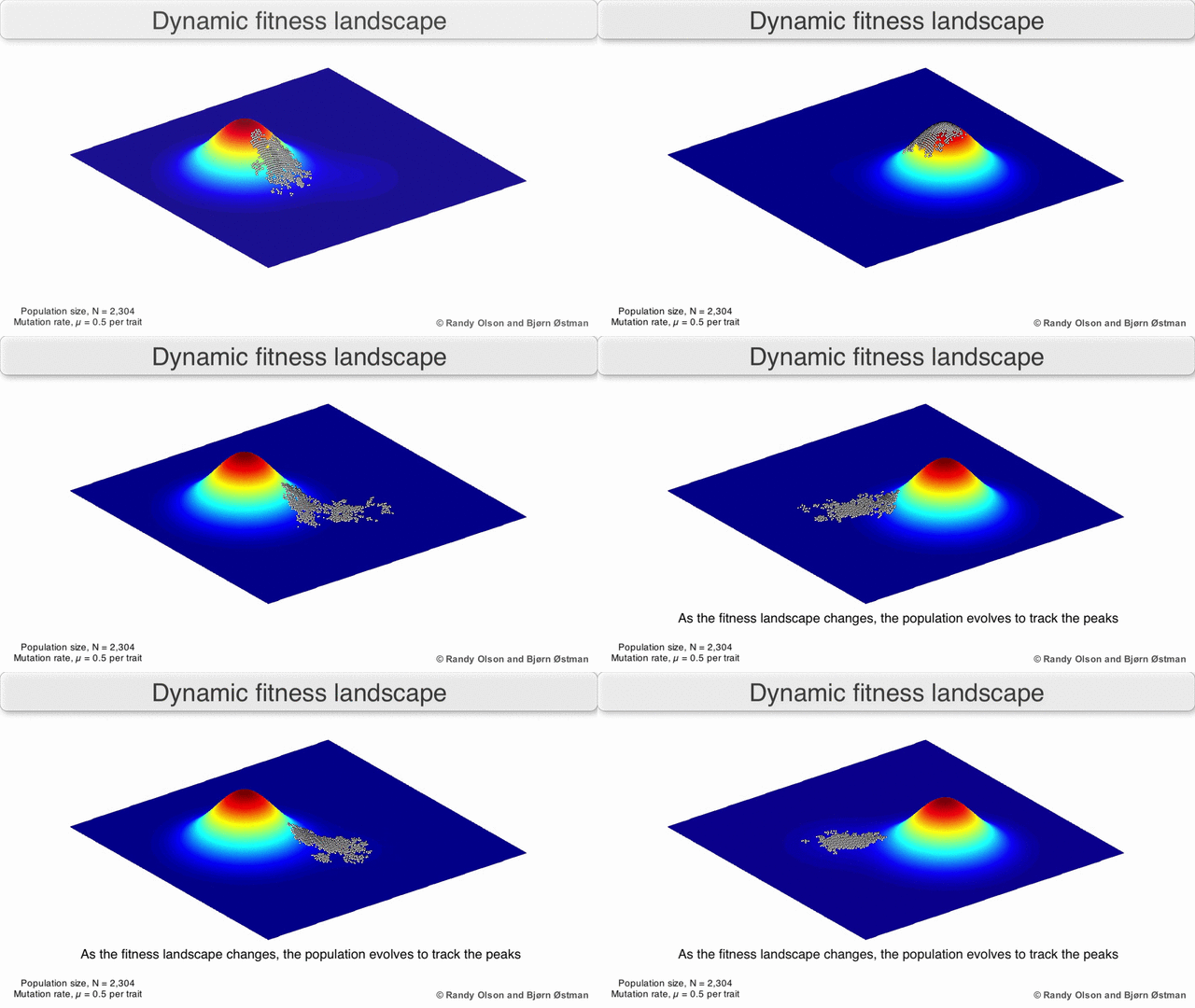
The main idea, as this Wikipedia GIF illustrates, is that agents look around, and then "hill climb" to the highest point that is near them. They then repeat this process until there is nowhere near them that is lower than them (that is, they are at a peak). In biology, peaks represent attributes with high reproductive success. In machine learning, they represent parameters with a better solution to a problem.
The result that you end up with (e.g., the attributes of an animal or the solution produced by a ML algorithm) depends on the fitness landscape, and on the location where you start. In general, you will end up at local, rather than global, peaks.
I think a lot about the interaction between technology and society, and I think that fitness landscapes can provide a useful way of thinking of them. Technology is sometimes talked about as though it causes certain political, cultural, or social outcomes. Alternatively, some people seem determined to act as though people act nearly independently of technology, and that technology is merely a tool.
I think that we can see the introduction of a new technology as a reshaping of the socio-cultural-political fitness landscape, so that some configurations become comparatively more costly or difficult to maintain (i.e., move lower) while others become more attractive or possible (i.e., move higher). Whether a given society will change their configuration is dependent on how much the landscape changes (e.g., if the landscape changes dramatically, then most configurations will change) and where they are located on the fitness landscape (e.g., if the peak they are on remains a local optimum, then they will stay, even if the overall landscape has changed a lot).
These ideas can be imperfectly mapped to real situations. For example, we could see a country with strong institutions and a stable culture as being at a rather high local peak. Technological changes would therefore be less likely to result in reconfigurations. Similarly, minor changes in technology may only alter the landscape in small ways, but those small changes may be enough to cause societies to change drastically (the arguments about Twitter causing the Arab Spring can be framed in these terms).
For me, at least, I think this is a nice framework for thinking about what's happening without resorting to simple cause and effect explanations.

The main idea, as this Wikipedia GIF illustrates, is that agents look around, and then "hill climb" to the highest point that is near them. They then repeat this process until there is nowhere near them that is lower than them (that is, they are at a peak). In biology, peaks represent attributes with high reproductive success. In machine learning, they represent parameters with a better solution to a problem.
The result that you end up with (e.g., the attributes of an animal or the solution produced by a ML algorithm) depends on the fitness landscape, and on the location where you start. In general, you will end up at local, rather than global, peaks.
I think a lot about the interaction between technology and society, and I think that fitness landscapes can provide a useful way of thinking of them. Technology is sometimes talked about as though it causes certain political, cultural, or social outcomes. Alternatively, some people seem determined to act as though people act nearly independently of technology, and that technology is merely a tool.
I think that we can see the introduction of a new technology as a reshaping of the socio-cultural-political fitness landscape, so that some configurations become comparatively more costly or difficult to maintain (i.e., move lower) while others become more attractive or possible (i.e., move higher). Whether a given society will change their configuration is dependent on how much the landscape changes (e.g., if the landscape changes dramatically, then most configurations will change) and where they are located on the fitness landscape (e.g., if the peak they are on remains a local optimum, then they will stay, even if the overall landscape has changed a lot).
These ideas can be imperfectly mapped to real situations. For example, we could see a country with strong institutions and a stable culture as being at a rather high local peak. Technological changes would therefore be less likely to result in reconfigurations. Similarly, minor changes in technology may only alter the landscape in small ways, but those small changes may be enough to cause societies to change drastically (the arguments about Twitter causing the Arab Spring can be framed in these terms).
For me, at least, I think this is a nice framework for thinking about what's happening without resorting to simple cause and effect explanations.
September 12, 2014
Every Generation Makes the World Anew
This is probably something obvious to most people, but it struck me the other day that so much of how we perceive and interact with the world - language, culture, how-to knowledge, etc. - is in practice quite stable and long-lived, but in theory is very malleable and uncertain. As the title of this post says, each generation has to choose what to pass on - what books to preserve, what buildings to (not?) tear down, what songs to teach to their children, etc. The things they choose not to pass on disappear. Forever.
I found that to be sobering.
September 2, 2014
The Web We Had
I recently finished the very good, classic work Small Pieces Loosely Joined, by David Weinberger. I enjoyed it very much (my brief review is here).
The book is 12 years old, however, and the Web has changed a lot in that time. While I found many of the ideas, especially the philosophical ideas about the Web, both insightful and applicable, as I was reading, I couldn't help but think about the ways in which the Web has drifted from the Web Weinberger knew in 2002.
In fact, coincidentally, Weinberger himself recently wrote about one of the ways that the web changed since then. Weinberger knew that it was social, but in the early days, that sociability was built almost exclusively around interests - mailing lists, irc channels, forums, blogs - they are all built around people interested in the content that is produced. Now, much more of the experience of the web is built around real-world relationships - Facebook, Snapchat, Twitter, etc. For most people, these are populated primarily with people who they know. In ways that are both good and bad, the web is more intimate and more insular than it was.
Secondly, the web was a purpose-built place. Many of Weinberger's arguments revolve around the idea that the web is a place apart from the "real world" - where what is created is created intentionally, and build around the interests of its creators. While the core of this claim is still true today, much of the web is now co-created with algorithms.
There are very few web pages that are designed exactly as they are. Most pages at least have ads which are chosen and served up by an algorithm. Many are created by algorithms in even more explicit ways. For example, Amazon suggests other items that you might be interested in, based on what similar consumers purchased in the past. Your Facebook feed is filtered based on the relationships you have with others - how many times you've liked someone's posts, how many friends you have in common, etc.
This is really interesting - we are living in a space that is altered based on what browser we are using, what sites we have visited, what purchases we have made, etc. It's as though when you went to the mall, all the stores you like were put closest to the entrance, and the salad places magically disappeared from the food court. Then, when the next person came in, their favorite stores and food magically moved to prime locations.
There are some dangers. The idea of a filter bubble is one - the idea is that it is good for us to be exposed to things we don't like, ideas we disagree with, etc. While I agree that this is something to worry about, let's not forget how amazing what we have is - the algorithm-based world of the web is one with better ads, more interesting content, and ways to find and connect with others who have things to say which are particularly interesting to us.
The book is 12 years old, however, and the Web has changed a lot in that time. While I found many of the ideas, especially the philosophical ideas about the Web, both insightful and applicable, as I was reading, I couldn't help but think about the ways in which the Web has drifted from the Web Weinberger knew in 2002.
In fact, coincidentally, Weinberger himself recently wrote about one of the ways that the web changed since then. Weinberger knew that it was social, but in the early days, that sociability was built almost exclusively around interests - mailing lists, irc channels, forums, blogs - they are all built around people interested in the content that is produced. Now, much more of the experience of the web is built around real-world relationships - Facebook, Snapchat, Twitter, etc. For most people, these are populated primarily with people who they know. In ways that are both good and bad, the web is more intimate and more insular than it was.
Secondly, the web was a purpose-built place. Many of Weinberger's arguments revolve around the idea that the web is a place apart from the "real world" - where what is created is created intentionally, and build around the interests of its creators. While the core of this claim is still true today, much of the web is now co-created with algorithms.
There are very few web pages that are designed exactly as they are. Most pages at least have ads which are chosen and served up by an algorithm. Many are created by algorithms in even more explicit ways. For example, Amazon suggests other items that you might be interested in, based on what similar consumers purchased in the past. Your Facebook feed is filtered based on the relationships you have with others - how many times you've liked someone's posts, how many friends you have in common, etc.
This is really interesting - we are living in a space that is altered based on what browser we are using, what sites we have visited, what purchases we have made, etc. It's as though when you went to the mall, all the stores you like were put closest to the entrance, and the salad places magically disappeared from the food court. Then, when the next person came in, their favorite stores and food magically moved to prime locations.
There are some dangers. The idea of a filter bubble is one - the idea is that it is good for us to be exposed to things we don't like, ideas we disagree with, etc. While I agree that this is something to worry about, let's not forget how amazing what we have is - the algorithm-based world of the web is one with better ads, more interesting content, and ways to find and connect with others who have things to say which are particularly interesting to us.
August 26, 2014
Review: Small Pieces Loosely Joined: A Unified Theory Of The Web

Small Pieces Loosely Joined: A Unified Theory Of The Web by David Weinberger
My rating: 4 of 5 stars
Only on the web does a book 12 years old feel like ancient history. In many respects, Weinberger was prescient, identifying trends that have become more and more powerful (e.g., one passage could be seen as predicting the rise of Wikipedia, and another the advent of the currently omnipresent "Like" button). Even more often, he provides insights that are still deep and thought-provoking.
Weinberger is a philosopher by training, and this book is strongest when Weinberger focuses on philosophy. For example, he argues that the web is a push back against the turn toward realism in society. He argues that the web is a completely constructed space, without the constraints of the real world, and the fact that we can find such meaning and purpose through that sort of "unreal" environment says something about what our real needs and desires are.
At times, the book is overly technological deterministic, and at times Weinberger makes claims about the nature of the web that may have been true 12 years ago, but feel less true today (e.g., today's web is much more organized around real-world friends and less around interests). However, I find his argument that using the Internet subtly changes the way we see the world to be both persuasive and important. Just because the Internet isn't "changing everything" rapidly before our eyes doesn't mean that there it isn't influencing culture in really important ways.
Overall, an important and interesting book. Should be required reading for anyone interested in the cultural impact of the internet.
View all my reviews
Review: It's Complicated: The Social Lives of Networked Teens

It's Complicated: The Social Lives of Networked Teens by Danah Boyd
My rating: 4 of 5 stars
boyd is an ethnographer of teens and technology. She has spent the past decade observing and talking with teens about how they use technology.
Like much of the recent literature on the web, I would characterize the overall takeaway as, "Plus ça change, plus c'est la même chose." Phones and the internet are not changing teenagers into new creatures, who hide themselves away in their rooms, lit only by the screen of their phone and laptop, furtively typing and texting - alone together.
Rather, boyd argues that much of the tech-centricity of the lives of teenagers is a result of a shift in societal norms. Parents no longer allow teens to hang out together; malls and other public places have also started to disallow groups of teens to congregate. boyd claims that teens would prefer to spend time face-to-face with each other - technology is simply the next best alternative in a society that is making that more and more difficult.
I find myself to be something more of a technological determinist than boyd, and I think that teens (and the rest of us) are being molded by our technology, although I agree that this is certainly more subtle than some earlier commentators on the web might have us believe.
View all my reviews
July 8, 2014
Facebook and Manipulation
I thought I would add my small voice to the large chorus of voices surrounding the recent Facebook study on mood manipulation.
Let me begin by saying that it's sort of fun to see social science getting so much attention! :) This is broadly my area of research (computational social science and online communities), and this is somewhat similar to the kinds of research I have done, and would like to do in the future.
So, naturally, I think that this sort of research is OK to do. I'll leave out the question of informed consent for now (although it's certainly important), and give a few reasons why I think that this sort of research is important and should be done.
Let me begin by saying that it's sort of fun to see social science getting so much attention! :) This is broadly my area of research (computational social science and online communities), and this is somewhat similar to the kinds of research I have done, and would like to do in the future.
So, naturally, I think that this sort of research is OK to do. I'll leave out the question of informed consent for now (although it's certainly important), and give a few reasons why I think that this sort of research is important and should be done.
- Websites provide a great way to study the understudied. For years, the main source of our knowledge about human psychology has been college undergraduates. Facebook users provide a much, much broader group of participants (although certainly still skewed toward Westerners).
Using these sites as a context for research should allow us to be more representative in the way we understand the world (and therefore in how we create policy based on that research). -
Critics of this research underestimate our autonomy. The press around this has acted as though Facebook's experiment was causing suicides, and creating chaos around the world. This is similar to the "magic bullet" theory of communication. Some early Communication scholars thought that messages from the media could directly influence people.
In reality, messages from the media (or our friends) combine in a very complicated way, and we choose how to respond and react. Indeed, the effect of the Facebook study was just barely statistically significant - people were barely, barely more likely to post positive things when reading positive things, and barely, barely more likely to post negative things when reading more negative things. - This leads to my next point. There are opportunities for real insight. My wife has been incredibly supportive of my career, but she studied genetics, and doesn't appreciate the social sciences as much as I do. She often says that the results of social science are obvious. I argue that the results seem obvious in retrospect, but that the opposite result would also seem obvious.
For example, one of the arguments against this study is that Facebook was intentionally making people sad by showing them more negative posts. However, previous research actually suggested that when people saw lots of positive posts they became more sad - they would see all the great things their friends were doing, and become depressed by comparison. The Facebook study showed that this isn't true - an important finding. -
This is related to my main point. We are spending more and more of our time on these types of sites. We need to understand them. Facebook and other sites have every right (IMO) to run these sorts of experiments in order to improve the experience of users. We can either encourage them to publish their findings, and make their insights available to the public, or we can criticize their research, and encourage them to keep it private, and manipulate our behavior without our knowledge.
I prefer the former.
January 18, 2014
Timebombing and Algorithms: Our co-created culture
I've been thinking a lot lately about how the creation of culture is no longer solely influenced by norms, but is co-created by algorithms.
Algorithm has a technical definition, as basically a series of instructions to produce a given set of outputs from a given set of inputs, but I'm focusing on a more specialized definition - I'm thinking of code that affects the way that users interact with information. For example, my working definition would include the algorithm that determines the ranking of Google's search results, but not an algorithm for determining whether a triangle is obtuse.
In his wonderful book Code 2.0, Lawrence Lessig describes how norms, law, architecture (which includes code), and the market all regulate/influence behavior.
My argument is related, and partially addressed by Lessig. Namely, it is that in online spaces norms and algorithms co-evolve in really interesting ways.
Algorithms are becoming more and more complex. In order to deal with the huge amount of information that is being created online, we need to have filters, filters which come from algorithms. For the most part, these algorithms are completely invisible to the user, and in many cases they are incredibly complex. For example, Google uses more than 200 signals to rank search results and Facebook's algorithm uses a number of features to determine how close you are to each of your "friends", and which of their updates should appear.
The invisibility of these algorithms has its own, potentially serious, problems. There is another problem with algorithms - they are rigid, and they are well-defined. This leaves room for people to "game the system" - that is, to interact in ways that were either unanticipated by the developers or which are difficult to identify and stop.
Cultural norms, on the other hand, are "fuzzy". They are heuristics, which we must decide to apply in ambiguous situations. For example, there is a norm of reciprocity - if someone does something nice to you, then you are expected to do something nice in return. Exactly how to apply this varies greatly depending on the situation, and the relationship between the people involved.
My working theory is that norms sort of fill in the gaps where algorithms are either too rigid, or not well-defined enough, but that norms that can be well defined will eventually be codified as algorithms.
As an example, Facebook's news feed algorithm surfaces posts that are popular and/or recent. This measure of recency includes not only the post, but any activity on a post.
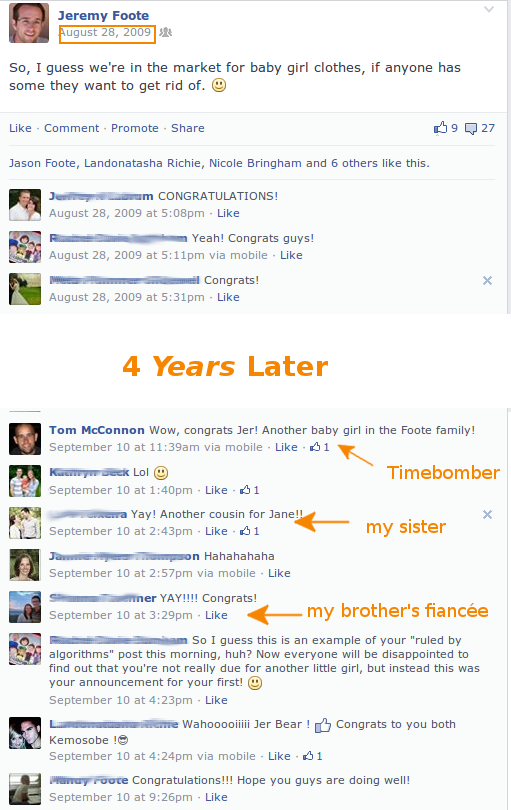
I know this because sometimes I participate in an activity that I call "Timebombing", where I comment on a friend's embarrassing and/or important post from years ago. For example, after telling a friend about how fun timebombing was, he commented on 4-year-old post which announced the pregnancy of our first child.
Soon, the post was filled with congratulatory comments from my friends and family, and people started calling to congratulate us for a non-existent pregnancy.

In this case, it's difficult for the news feed algorithm to differentiate between an old post that is important again, and an old post that someone is commenting on as a joke. Because this is so fuzzy, a norm has arisen which says that you shouldn't comment on old posts, unless your comment makes it clear that it's an old post.
If the behavior became widespread enough, then developers could potentially change the algorithm to reflect the importance of the norm, either by eliminating the problem (e.g., "Posts older than X years won't show up again no matter what"), or to make it less confusing (e.g., "Make the date of the original post larger or a different color if it's older than X days").
However, the rigidity and explicitness of code will always leave algorithms open to manipulation and abuse; in systems designed for social interaction, code will never be sufficient to stop undesirable behaviors, and norms will always play the most important role in guiding behavior.
Algorithm has a technical definition, as basically a series of instructions to produce a given set of outputs from a given set of inputs, but I'm focusing on a more specialized definition - I'm thinking of code that affects the way that users interact with information. For example, my working definition would include the algorithm that determines the ranking of Google's search results, but not an algorithm for determining whether a triangle is obtuse.
In his wonderful book Code 2.0, Lawrence Lessig describes how norms, law, architecture (which includes code), and the market all regulate/influence behavior.
My argument is related, and partially addressed by Lessig. Namely, it is that in online spaces norms and algorithms co-evolve in really interesting ways.
Algorithms are becoming more and more complex. In order to deal with the huge amount of information that is being created online, we need to have filters, filters which come from algorithms. For the most part, these algorithms are completely invisible to the user, and in many cases they are incredibly complex. For example, Google uses more than 200 signals to rank search results and Facebook's algorithm uses a number of features to determine how close you are to each of your "friends", and which of their updates should appear.
The invisibility of these algorithms has its own, potentially serious, problems. There is another problem with algorithms - they are rigid, and they are well-defined. This leaves room for people to "game the system" - that is, to interact in ways that were either unanticipated by the developers or which are difficult to identify and stop.
Cultural norms, on the other hand, are "fuzzy". They are heuristics, which we must decide to apply in ambiguous situations. For example, there is a norm of reciprocity - if someone does something nice to you, then you are expected to do something nice in return. Exactly how to apply this varies greatly depending on the situation, and the relationship between the people involved.
My working theory is that norms sort of fill in the gaps where algorithms are either too rigid, or not well-defined enough, but that norms that can be well defined will eventually be codified as algorithms.
As an example, Facebook's news feed algorithm surfaces posts that are popular and/or recent. This measure of recency includes not only the post, but any activity on a post.
Soon, the post was filled with congratulatory comments from my friends and family, and people started calling to congratulate us for a non-existent pregnancy.
In this case, it's difficult for the news feed algorithm to differentiate between an old post that is important again, and an old post that someone is commenting on as a joke. Because this is so fuzzy, a norm has arisen which says that you shouldn't comment on old posts, unless your comment makes it clear that it's an old post.
If the behavior became widespread enough, then developers could potentially change the algorithm to reflect the importance of the norm, either by eliminating the problem (e.g., "Posts older than X years won't show up again no matter what"), or to make it less confusing (e.g., "Make the date of the original post larger or a different color if it's older than X days").
However, the rigidity and explicitness of code will always leave algorithms open to manipulation and abuse; in systems designed for social interaction, code will never be sufficient to stop undesirable behaviors, and norms will always play the most important role in guiding behavior.
September 14, 2013
On Small Changes
Democracy via Newspaper
Before newspapers, people could (and did) distribute hand-written bulletins. In fact, the only major advantage of newspapers was the volume that could be produced. The sorts of things that could be written about didn't change, the labor-intensive means of distribution were the same. And yet, this small change may have been enough to make the rise of democratic nation-states possible. Elihu Katz summarizes this argument (as made by Gabriel Tarde):
But Tarde takes a further step in this role, in asserting that the newspaper overthrew the monarchy. His argument is based on the idea that only the king — the representative public sphere — had had knowledge of what was going on in the various villages and regions of his realm; he had spies and bureaucrats to tell him, and he was in no special hurry to let Village A find out what Village B was thinking. The newspaper did exactly this and thereby undermined the king, says Tarde: it made him redundant. (Katz, 2000, p. 126)The claim is that the king was in a position to bridge structural holes, and to decide how and when to distribute what information between villages. This information asymmetry provided power and control, and when newspapers removed some of that asymmetry, the monarchy was too weak to survive.
Similar claims have been made about the power of technologies to alter societies. For example, Eisenstein's description of the printing press or Putnam's argument that TV killed socializing.
My point is not to discuss the merit of any of these arguments (although I think all 3 are fascinating and compelling). However, I think that the underlying theme behind them is important and interesting: Changes in communication technologies have subtle effects on the way we see each other, and the way we see the world. And these subtle changes can make a huge difference in the way we choose to work, play, and govern ourselves.
? Via The Internet
My next question, naturally, is what aspects of the Internet (if any) have the potential to have these sorts of long-term impacts (with the caveat that by their nature these changes are hard to see when you are in the midst of them)?
Some ideas:
- Global information and communication → Weakening of Nationalism → Less wars
- Filter Bubbles → Strengthening of Zealots → More wars
- EBay → Temporary view of posession → Collaborative Consumption → Weakening of capitalism/consumerism → ?
- Digitization of activity → Surveillance (by states and others) → Distrust of government
- Digitization of activity → Surveillance (by states and others) → Less crime
- Digitization of activity → Surveillance by algorithms → Less crime?
What else? Are some big effects already occurring?
Reference
Katz, E. (2000). Media multiplication and social segmentation. Departmental Papers (ASC), 161.
May 7, 2013
Exploring Dead Ends
 |
| Photo via C.G.P. Grey |
Unless you have an unhealthy belief in your good luck, this is a simple choice - for rational actors, when faced with a choice, it makes the most sense to choose the option with the highest expected value. A sure $5 is much better than the likely loss of $50, even though the maximum gain is less.
One of the reasons that I think evolution-type processes are so powerful and interesting is that they are too dumb to avoid bad decisions. Evolution "chooses" the second set of rules - it explores lots of dead ends, lots of poor designs, but because it is willing to suffer these losses, it also discovers options and makes advances that rational algorithms will always avoid.
January 12, 2013
Diffusion of Community
As mentioned in my last post, I've been reading about early online communities, specifically "The Well". In these early days, you didn't connect to "The Internet", but you used your modem to dial into a specific computer. When you got on The Well, you were on The Well. There were different topics to discuss, etc., but it was just one "place", all designed and run by the same people.
My suspicion is that the narrowness of the community helped to give identity and cohesion to the members of The Well. The online landscape of today is strikingly different, and there are a few ways that I think make community-building more difficult.
First, community cohesion means choosing a community that is "yours", and with so many communities, I think it's easy to try to be a part of all of them, without really joining any of them. I have edited Wikipedia articles and answered questions on Quora and written blog posts, and taken Udacity courses, etc., without becoming involved in any of the communities.
Second, our experience of communities is in many cases individualized. Our Facebook news feed isn't the same as anyone else's, nor is our Twitter feed, Quora homepage, etc. Part of community is shared experience, and our filtered versions of the world mean that we experience online community differently.
I'm not sure whether this is good or bad. I guess, as I read these memoirs of the early days of Internet life, it makes me wish that that same sense of deep belonging still existed, and has led me to think about what has changed.
My suspicion is that the narrowness of the community helped to give identity and cohesion to the members of The Well. The online landscape of today is strikingly different, and there are a few ways that I think make community-building more difficult.
First, community cohesion means choosing a community that is "yours", and with so many communities, I think it's easy to try to be a part of all of them, without really joining any of them. I have edited Wikipedia articles and answered questions on Quora and written blog posts, and taken Udacity courses, etc., without becoming involved in any of the communities.
Second, our experience of communities is in many cases individualized. Our Facebook news feed isn't the same as anyone else's, nor is our Twitter feed, Quora homepage, etc. Part of community is shared experience, and our filtered versions of the world mean that we experience online community differently.
I'm not sure whether this is good or bad. I guess, as I read these memoirs of the early days of Internet life, it makes me wish that that same sense of deep belonging still existed, and has led me to think about what has changed.
January 9, 2013
The Longevity of Conversation
For one of my classes, I've been reading about The Well, and other early online communities (yes - it's very cool that I get paid - a little - to study this stuff). It is incredible to me that many of the archives of this and similar communities still exist. You can see, for example, Linus Torvald's first post proposing Linux. We can view and replay significant moments in incredible detail.
And most incredibly, we can do this with the benefit of hindsight. "Everything" is saved, so conversations (like Linus's) that seemed unimportant at the time, are still around, and can be analyzed in the context of their realized importance.
This memory of the web does have some downsides, however. One of the striking things about The Well is just how open and passionate people are, and that passion built a vibrant community. Before posting to the Web, I find myself self-censoring, because the medium can be so unforgiving, and I don't engage as fully as I think I would if the Web forgot.
And most incredibly, we can do this with the benefit of hindsight. "Everything" is saved, so conversations (like Linus's) that seemed unimportant at the time, are still around, and can be analyzed in the context of their realized importance.
This memory of the web does have some downsides, however. One of the striking things about The Well is just how open and passionate people are, and that passion built a vibrant community. Before posting to the Web, I find myself self-censoring, because the medium can be so unforgiving, and I don't engage as fully as I think I would if the Web forgot.
November 20, 2012
The Lottery of Birth
The basic argument is that
laws and other social systems should be designed as though by a premortal agent whose birthplace, intelligence, etc. would all be determined by lottery. Warren Buffett describes it wonderfully in the embedded video.
Anyway, I was thinking about another aspect of the birth lottery. As Warren Buffett argues, he is very lucky to have been born in a time and place where his skills are valued and rewarded. At almost any point in human history, or in most other places in the world, being able to allocate capital is a fairly useless skill.
This made me think about how many people were not so lucky. Right now we think of the greatest painters in human history as Da Vinci, Michaelangelo, Picasso, etc. The list will certainly vary depending on who makes it. However, whatever list we make misses out on all of the people who would have been great painters, but either lived at the wrong time or place, or just never explored that skill. In fact, I would argue, it is almost certain that the (potential) greatest painter that ever lived was not a painter. Our mystery painter was born before paint was invented, or born in rural China, or most likely, she was a woman (a lottery ticket that has generally excluded half of the population from exploring many of their skills).
There is something tragic in this view of the world - for every skill, the person with the most natural aptitude almost certainly never found their calling. The greatest (potential) poet may be an unhappy accountant, the greatest pianist an Indian peasant, the greatest unicyclist a mediocre Math teacher.
This is one reason that I think capitalism is so needed - it encourages people to explore their talents in the areas that are most valuable to society. And yet, it is still wildly inefficient in the sense that the entire space of possible talents is so vast that it cannot be explored, and natural abilities are still only poorly matched with occupations.
As I was writing this post, I came across Kevin Kelly's very similar, technological version of this argument, and realized that I had read it, and it probably served as a subconscious prompt for my thinking.
August 22, 2012
Goodreads Reviews
I'm experimenting with cross-posting some of my GoodReads reviews here on the blog. If either of my blog readers want me to stop doing that, please let me know. :)
Review: Alone Together: Why We Expect More from Technology and Less from Each Other

Alone Together: Why We Expect More from Technology and Less from Each Other by Sherry Turkle
My rating: 4 of 5 stars
My natural inclination is toward technological optimism, and toward quantitative research. This book doesn't have much of either. As I began the book, I found myself arguing with Dr. Turkle's assumptions and the obvious coloring that her preconceived ideas gave her research. I longed for objectivity and proof.
While I still think that Dr. Turkle's arguments would be bolstered by a more objective, data-based approach, I began to see the value of her research. She writes about mothers who pay more attention to their phones than to their kids, and kids who are hurt because a robot doesn't respond to them. These sorts of stories really do relate something about our relationship with technology that pure data can't.
I do think that the book is intentionally pessimistic, however. Positive examples of people interacting with technology were few and far between. Even though we all experience the positive effects of technology daily, Dr. Turkle very nearly ignored any positives, potential or realized, and focused on dangers and problems.
View all my reviews
July 1, 2012
Communications Revolutions
 Communications technologies want to move along three continua (which I just learned is awesomely the plural of continuum).
They move along an interactivity continuum, from one-to-one interactions toward many-to-many interactions. They move along an immediacy continuum, from synchronous toward asynchronous communication. And they move along a spatial continuum, from being available only locally toward being accessible from anywhere (what I'll call aspatial).
Each major communications breakthrough has moved us further along one or another of these continua.
Language was the first communications breakthrough. Speaking is one-to-some, synchronous, and local.
Writing is also one-to-some and local (you have to have the book to read it), but asynchronous. Written works are persistent, and can be read at any time.
The printing press changed writing to be one-to-many, but it remained local.
The telegraph was the first non-local communication technology, in that for the first time, a message could be transmitted from any distance almost immediately, so that the location of the original message was no longer important. Telegraphs moved backwards on the other two continua, however. They are both one-to-one and synchronous (telegraphs were sent to a specific telegraph office, where someone had to be there to receive them). I would put telephones in this same camp.
Mass media (radio and TV) brought about aspatial, one-to-many communications, but they are still synchronous.
The Internet provides us, for the first time, with communications that are both asynchronous (websites can be viewed at any time, not just when they are created) and aspatial (you can view a website from anywhere). The Internet also enables many-to-many conversations, where lots of people can discuss, organize, etc.
I think that the next step is for the Internet to bring its attributes to other aspects of the world. It is already reaching back to other technologies to make printed works aspatial (e.g., Google Books) and mass media asynchronous (e.g. Hulu or Netflix). It is making buying and selling aspatial (e.g., eBay) and asynchronous (e.g., Amazon).
Image via starfire2k on Flickr
June 5, 2012
What Computers Want
 | |
| Correlation isn't causation, but "Jeremy" and "cool" both started surging around the year I was born |
In a larger sense, I think that computers affect the way that we see the world. For the first time ever, we can store and manipulate huge amounts of data - we can quantify things that never seemed quantifiable before. For example, Google's Ngram Viewer allows you to analyze millions of published works to see how phrases have become more or less popular over time. People have used this as a way to quantify culture.
There is danger, however, in thinking that everything can be quantified. As Jaron Lanier argues in You Are Not a Gadget, when we quantify our lives, we may be tempted to think that they are fully quantifiable. Or worse - we may begin to live quantifiable lives. He argues that Facebook is "organizing people into multiple-choice identities", and that if we continually describe ourselves in those sorts of terms, then we may become flatter, describable, and boring people.
My deeper reaction, though, is that this is really cool. I think it's amazing that we can track all of the websites we visit, or how many steps we take or all of the places that we go, and find patterns and meaning. Thinking like a computer leads to a whole new way of seeing the world.
For example, Google took over search because they came up with the idea of tracking all of the links that go between websites. Before Google, search engines searched based on just the content of the page (or searched a human-created directory of websites). Larry and Sergey's great insight was that there was data in the network, not just in the nodes.
There are plenty of other examples of the insights gained from this sort of computational thinking - on Hunch.com they track correlations of how people answer questions. For example, they know that gel pen users are significantly more likely to drive to work than pencil users. Most of that is silly, but the fact that we can track and share these things is really cool, and I think that we will continue to find insights.
"Craigslisting" Higher Education
 I just completed my second course on Udacity. In seven weeks, I learned the material covered in a semester-long college course, taught by one of the premier scientists in the field. I watched lectures when I wanted, and at the pace I wanted. It was a great experience - I learned the content in a way that was better than a college course in almost every way.
In short, online education is very quickly approaching the point where it is better than traditional education. That got me thinking about what will happen as people start to move toward online education.
As Craigslist began to put newspapers out of business, we realized that news is a public good, subsidized by classified ads, and that as ads become less profitable, we risk losing the benefits of newspapers.
Similarly, I wonder if the research that goes on at universities is a public good that is subsidized by tuition. As learning becomes cheaper and moves online, what will happen to that research? Are universities about to be "craigslisted"?
February 20, 2012
Leveling Up
 At some level of size and interconnectedness, interacting individuals become something other than the sum of their parts. Our history is filled with examples.
Mutlicellularity began with independent single-celled organisms, interacting with each other. As those interactions became more complex, they began to act as a single organism. By working together, they could avoid being eaten, attack larger organisms, etc. They began to divide the tasks of survival, until eventually, they became one organism.
At that point, organisms could act on the world (and be acted upon) on two levels. Because the cells work so closely together, natural selection began to work on the organism as a whole instead of just on the cells. This led to the creation of a middle "level" of organization, in between cells and organisms: organs. Organs are groups of specialized cells. The cells communicate with each other in order to make the organ work, but they also communicate, as an organ, with other organs.
Thus, all of us are composed of levels of semi-independent, interconnecting parts. Although each level is composed only of its parts, it is something greater and different from the sum of those parts, and an attempt to understand one level by understanding its components misses out on this fact.
For example, we could be described as a bundle of interacting organs. We could (theoretically) map out exactly how each of those organs interacts with each other, and this would describe humans and their behavior convincingly. It would miss out, however, on what it means to be human. We are living the interaction between those organs, and it is something more than a medical school diagram.
Similarly, we could describe our lungs by mapping out how each of the cells acts and reacts to stimuli, but we would be missing out on the fact that the lung is not just cells, but a breathing machine. Understanding how each cell works does not describe how they work together, because they are doing something at a different level.
This exercise works all the way down. Understanding organelles is not the same as understanding the life of a cell; understanding protons and neutrons misses out on most of what chemistry is, etc.
The second half of my argument is that this complexity - this "levelling up", happens because it is beneficial to be able to interact at another level. Companies are nothing more than a group of people connected together, yet they can make commitments, sign contracts, etc. Even if all of the people who sign a contract for a company are fired, the contract is still in effect. Despite all of the brouhaha over "corporate personhood", in some real sense corporations are, if not people, agents that can act and be held responsible for their actions.
This is a very good thing. If Boeing had to get agreement from all of its employees before making a government contract, then it would never happen. By acting as one organism, the members of a corporation can make decisions and agreements that would not be possible as individuals, or even as a group.
The big unanswered question is whether there are other levels. Do economies, countries, or the Internet have a sort of autonomy?
At that point, organisms could act on the world (and be acted upon) on two levels. Because the cells work so closely together, natural selection began to work on the organism as a whole instead of just on the cells. This led to the creation of a middle "level" of organization, in between cells and organisms: organs. Organs are groups of specialized cells. The cells communicate with each other in order to make the organ work, but they also communicate, as an organ, with other organs.
Thus, all of us are composed of levels of semi-independent, interconnecting parts. Although each level is composed only of its parts, it is something greater and different from the sum of those parts, and an attempt to understand one level by understanding its components misses out on this fact.
For example, we could be described as a bundle of interacting organs. We could (theoretically) map out exactly how each of those organs interacts with each other, and this would describe humans and their behavior convincingly. It would miss out, however, on what it means to be human. We are living the interaction between those organs, and it is something more than a medical school diagram.
Similarly, we could describe our lungs by mapping out how each of the cells acts and reacts to stimuli, but we would be missing out on the fact that the lung is not just cells, but a breathing machine. Understanding how each cell works does not describe how they work together, because they are doing something at a different level.
This exercise works all the way down. Understanding organelles is not the same as understanding the life of a cell; understanding protons and neutrons misses out on most of what chemistry is, etc.
The second half of my argument is that this complexity - this "levelling up", happens because it is beneficial to be able to interact at another level. Companies are nothing more than a group of people connected together, yet they can make commitments, sign contracts, etc. Even if all of the people who sign a contract for a company are fired, the contract is still in effect. Despite all of the brouhaha over "corporate personhood", in some real sense corporations are, if not people, agents that can act and be held responsible for their actions.
This is a very good thing. If Boeing had to get agreement from all of its employees before making a government contract, then it would never happen. By acting as one organism, the members of a corporation can make decisions and agreements that would not be possible as individuals, or even as a group.
The big unanswered question is whether there are other levels. Do economies, countries, or the Internet have a sort of autonomy?
December 28, 2011
My 2011 Reading Highlights
Here are some books that I really enjoyed from 2011 (i.e., I read them in 2011 - many of them were published long ago):
Everything is Obvious
The Master Switch: The Rise and Fall of Information Empires
A Soldier of the Great War
Microcosm: E. coli and the New Science of Life
The Rational Optimist: How Prosperity Evolves
All Quiet on the Western Front
Unbroken: A World War II Story of Survival, Resilience, and Redemption
Right now I'm reading these:
The Penguin and the Leviathan: How Cooperation Triumphs over Self-Interest
To Draw Closer to God: A Collection of Discourses
I'm also on Goodreads.
Everything is Obvious
The Master Switch: The Rise and Fall of Information Empires
A Soldier of the Great War
Microcosm: E. coli and the New Science of Life
The Rational Optimist: How Prosperity Evolves
All Quiet on the Western Front
Unbroken: A World War II Story of Survival, Resilience, and Redemption
Right now I'm reading these:
The Penguin and the Leviathan: How Cooperation Triumphs over Self-Interest
To Draw Closer to God: A Collection of Discourses
I'm also on Goodreads.
Subscribe to:
Posts (Atom)